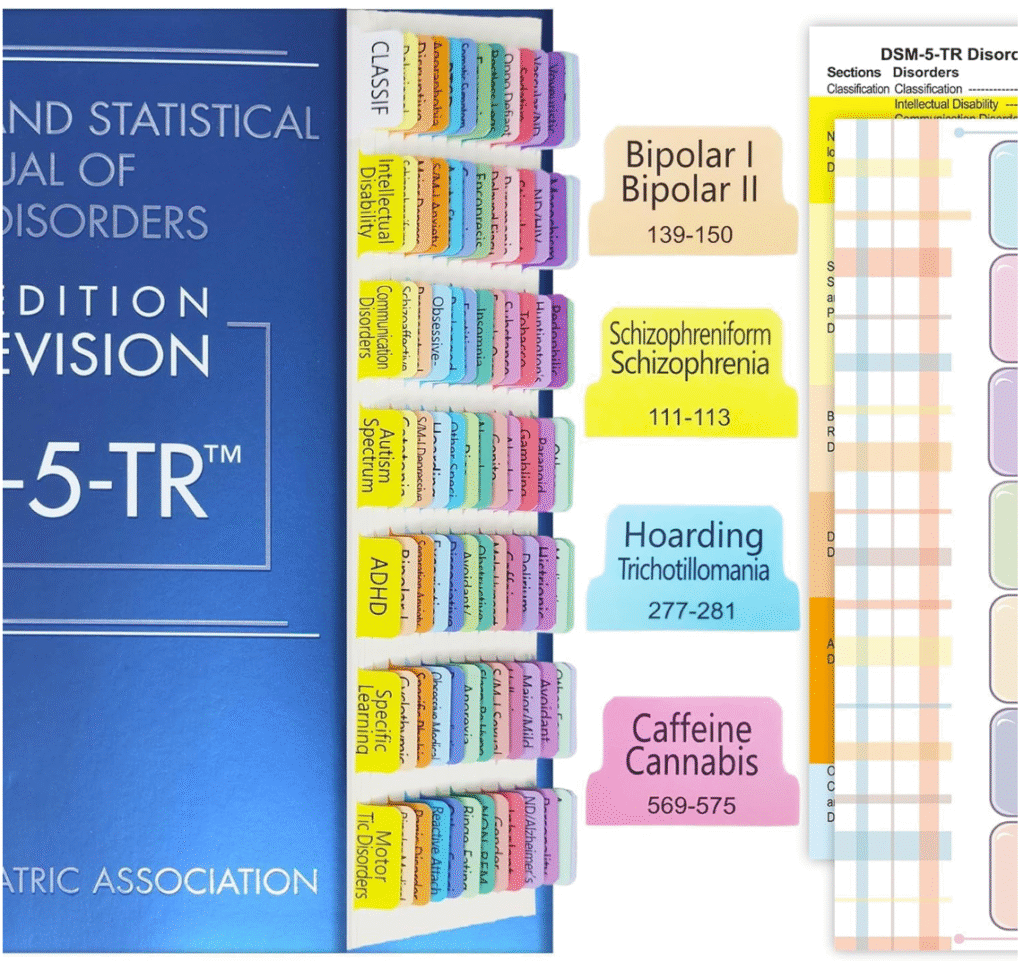
Introduction to DSM-5-TR Index Tabs
The Diagnostic and Statistical Manual of Mental Disorders, Fifth Edition, Text Revision (DSM-5-TR) serves as a critical framework within the mental health field for diagnosing and classifying mental disorders. Published by the American Psychiatric Association, it represents a culmination of extensive research and clinical insights, ensuring that mental health professionals possess a comprehensive and accessible tool for effective diagnosis and treatment planning. The DSM-5-TR is utilized widely among psychiatrists, psychologists, and other mental health practitioners, thus making its navigability paramount for efficient clinical practice.
Index tabs are an essential component of the DSM-5-TR, designed to facilitate straightforward navigation through the extensive content of the manual. They aid clinicians in quickly locating vital information related to various mental health disorders, diagnostic criteria, and relevant treatment approaches. Given the complex nature of mental health diagnostics, well-organized index tabs can significantly enhance the efficiency of the diagnostic process, allowing practitioners to focus more on patient care rather than on locating information.
The recent upgraded versions of these index tabs contribute to this efficiency by improving usability through enhanced design and clearer categorizations. Unlike digital alternatives, printed index tabs offer immediate accessibility during clinical assessments, particularly in fast-paced environments where time is of the essence. Their tactile nature allows for quick referencing without the need for electronic devices, reducing potential distractions or technical challenges that may arise when using digital formats. Furthermore, having physical tabs can assist in maintaining continuity in practice, where quick access to essential information can foster more effective clinician-patient interactions.
Thus, the integration of upgraded index tabs into the DSM-5-TR not only streamlines the navigation of the manual but also emphasizes the importance of ease of access in clinical settings. This enhancement ultimately promotes more accurate diagnoses and better-informed treatment strategies, ultimately benefitting mental health outcomes.
Features of the Upgraded Index Tabs
The upgraded index tabs for the DSM-5-TR 2022 offer a range of features that enhance both functionality and user experience. This set includes 94 printed tabs, each designed for clarity and organization, allowing professionals to navigate through the text with ease. The design of these tabs is not only intuitive but also ensures that essential information can be found swiftly, improving efficiency during assessments or therapeutic activities.
In addition to the 94 main tabs, there is an alignment guide included in the total count of 100 tabs. This guide serves as a valuable tool for users, facilitating quicker reference and allowing for streamlined navigation of materials. This feature is particularly beneficial in environments where time is of the essence, such as clinical settings or academic research. The alignment guide ensures that users can locate information swiftly, minimizing disruptions to their workflow.
Durability is another noteworthy aspect of these upgraded index tabs. Constructed from high-quality materials, the tabs are designed to withstand frequent handling and usage, making them ideal for individuals who rely on the DSM-5-TR for daily practice. The easy application process allows practitioners to customize their reference set without difficulty, ensuring that the tabs adhere well to the pages without causing any damage. As a result, users can focus on utilizing the manual rather than worrying about wear and tear on their tools.
Overall, the upgraded index tabs for the DSM-5-TR 2022 exemplify enhanced usability and durability, making them an essential addition for professionals in the mental health field. Their thoughtful design provides significant support, contributing to better organization and access to critical information, thereby enriching the overall DSM-5-TR experience.
Benefits of Using Index Tabs in Clinical Practice
In the realm of clinical practice, the integration of index tabs into the DSM-5-TR has proven to be a transformative tool for mental health professionals. These convenient markers enhance the accessibility of critical information, allowing practitioners to streamline their workflow. By facilitating quick reference to diagnosis criteria, treatment options, and relevant guidelines, index tabs significantly reduce the time spent searching through the manual during patient sessions. This efficiency ultimately allows for more focused and meaningful interactions with clients.
A therapist in a busy practice recently shared, “Using index tabs has completely changed how I approach my sessions. Instead of flipping through pages searching for specific criteria, I can locate the information I need in seconds. This saves valuable time, enabling me to devote more attention to my patients.” This testimonial exemplifies the direct impact index tabs can have on improving clinical efficiency.
Moreover, index tabs not only assist in enhancing the diagnostic process but also aid in treatment planning. With the ability to readily examine evidence-based treatment options and associated disorders, practitioners are better equipped to develop comprehensive care plans tailored to the individual needs of their patients. One mental health counselor noted, “When I’m preparing for a session, having the DSM-5-TR organized with index tabs allows me to have all necessary information at my fingertips. This greatly assists in the continuity of care and ensures that no important details are overlooked.”
Ultimately, the incorporation of index tabs in the DSM-5-TR is a simple yet powerful enhancement that can lead to greater efficiency in clinical practice. By minimizing the time spent on navigating text and paperwork, mental health professionals can focus more energy on what truly matters: their clinical work and patient well-being.
How to Effectively Use Your DSM-5-TR Index Tabs
Utilizing the upgraded index tabs in the DSM-5-TR can significantly enhance the efficiency of your clinical practice. To get started, it is essential to properly apply the index tabs to the relevant sections. Begin by identifying the areas you frequent most, such as diagnostic criteria, treatment recommendations, or assessment tools. Carefully aligning the tabs with these sections will allow you to quickly access crucial information when needed.
Once the tabs are in place, consider developing a systematic organization strategy. Group similar diagnostic categories together to facilitate an efficient search process. For instance, placing tabs for mood disorders, anxiety disorders, and psychotic disorders in close proximity can streamline consultations, particularly in emergency settings. Additionally, utilizing the alignment guide provided with the index tabs can help you navigate the complex relationships between different disorders easily.
To maintain the integrity and longevity of your index tabs, handle them with care. Regularly check for wear and tear, ensuring they remain firmly attached and legible. If you find any tabs becoming loose or damaged, consider replacing them to maintain the visual organization of your DSM-5-TR. It is also advisable to store the manual in a protective case to avoid any potential physical damage.
Integrating these index tabs into your clinical routines is crucial for continuous improvement in practice. Establish a habit of using them during assessments and when formulating treatment plans. Furthermore, and importantly, customizing the tabs to reflect your personal preferences can further enhance functionality. This customization can vary from color coding for different categories to creating personalized notes to serve your specific organizational needs. By adopting these practical tips, you will maximize the efficiency of your DSM-5-TR experience.